Best Beaches for Solo Travelers in 2026
BEACH LIFE · SOLO TRAVEL
Best Beaches for Solo Travelers in 2026
The beach is underrated for solo travel — and these destinations prove it. Here’s where to go when it’s just you, the water, and no compromises on what you want to do.
There’s a specific freedom to solo beach travel that group trips rarely allow: you eat when you’re hungry, sleep when you’re tired, stay at that bar for another hour or leave it to walk back in the dark. You go where you want. You talk to strangers or you don’t. The beach strips away the usual social scaffolding and what’s left is either very peaceful or very clarifying — often both.
The right destination makes all the difference. Some beaches are built for solo travelers — social infrastructure, walkable areas, established travelers’ culture, and enough to do that downtime is a choice rather than a default. Others will leave you stranded at a resort with no way to meet anyone and nowhere to walk. Here are the ones that work.
What Makes a Beach Good for Solo Travel
Safety is the obvious factor, but it’s more nuanced than the general advice suggests. Solo beach travel is about managing a set of specific risks: petty theft on beaches, late-night transport, unfamiliar currents, and in some regions, scams targeting obvious tourists. The destinations below have established enough tourist infrastructure that these risks are manageable with reasonable precautions. None of them require extraordinary vigilance — just the same general awareness you’d apply anywhere.
Beyond safety: walkability, nightlife culture, ease of day trips, and the presence of other travelers who’ve built community (surf schools, dive shops, hostel common areas, beach bar regulars). The best solo beach destinations have places where you can reliably meet other people if you want to — and places to entirely disappear into solitude if you don’t.
1. Hội An, Vietnam
The ancient town of Hội An sits 4 kilometers from An Bàng Beach — one of the quieter, less developed stretches of central Vietnam’s coast. The combination is perfect for solo travelers: the beach itself provides the relaxation and swimming; the old town provides the social life, the food, the culture, and the community. Hội An has one of the most established solo-traveler cultures in Southeast Asia — the coffee shop-to-tailor shop-to-cooking class-to-boat trip sequence is well-worn, and exactly why it works.
The beach is calm from February through July; sea conditions pick up from September through November (swimming is inadvisable in typhoon season). The food is exceptional — Hội An’s Cao Lầu noodles and white rose dumplings are justification for a trip on their own. Budget travelers can live extraordinarily well here on $30–$50/day.
2. Tulum, Mexico
Tulum has become one of the world’s great solo traveler destinations, which is both its appeal and its challenge. The Mayan ruins-above-the-sea location makes it genuinely unique. The beach road hotel scene — thatched-roof boutiques, yoga retreats, sunset cocktails on clifftop restaurants — creates a dense social environment where meeting people is almost unavoidable. The cenotes (underground freshwater caves) scattered around the surrounding jungle provide some of the most surreal swimming experiences on earth.
The challenge: Tulum has become expensive and crowded by its own success. The road is poorly lit at night (bike with a light or take a taxi). And the “wellness” scene can feel performative if that’s not your thing. The solution is to go in shoulder season (May–June), stay on the beach road, and skip the DJ beach parties that have taken over the southern end.
3. Lisbon & Cascais, Portugal
Portugal’s Atlantic coast beaches are underrated for solo travel precisely because they don’t feel like a “beach destination” — they feel like a full country worth exploring that happens to have world-class beaches 20–40 minutes from the capital. Cascais is a charming seaside town 40 minutes by train from Lisbon, with several excellent beaches (Praia de Cascais, Praia do Guincho for the dramatic Atlantic surf), excellent food, and a comfortable, walkable scale. Nazaré in the winter hosts the world’s largest surf waves — genuinely spectacular to watch even if you’re not surfing.
Portugal is consistently rated one of Europe’s most welcoming destinations for solo travelers. English is widely spoken. The rail and bus network is excellent. Costs are lower than most Western Europe. And Lisbon itself — with its Fado music bars, tiled buildings, and hilltop viewpoints — provides more to do than most solo travelers can exhaust in a week.
4. Canggu & Seminyak, Bali
Bali is arguably the world’s most developed solo traveler infrastructure, and Canggu is its current hub. The surfing is excellent (Batu Bolong, Echo Beach — consistent breaks, good school infrastructure), the food is some of the best value-for-money anywhere (a full meal rarely exceeds $5–$8 at the warungs), and the combination of surf culture, yoga studios, beach clubs, and coworking spaces creates a community that mixes long-term remote workers with short-term travelers in productive and social ways.
The traffic in Canggu is genuinely terrible (Jl. Batu Bolong at any hour). The crowds have peaked from what they were five years ago. And the Airbnb villa model has priced out some of the more affordable guesthouse options. But for meeting people, eating exceptional food, surfing, and having access to the wider cultural richness of Bali — rice terraces, temples, Ubud — it remains one of the world’s best solo travel bases.
5. Oahu (Honolulu), Hawaii
Oahu works for solo travelers partly because it’s a real city (Honolulu) with the infrastructure that comes with that — public transit, diverse food options, a normal urban social life — attached to some of the world’s most famous beaches. Waikiki is accessible, safe, walkable, and provides a full social environment including the Kalakaua Avenue strip of restaurants and bars. The North Shore from November to February has the world’s most dramatic surf watching. Diamond Head is a half-day hike. Hanauma Bay provides one of the most accessible coral reef snorkel sites in the Pacific.
The solo-travel challenge on Hawaii is cost. Oahu is genuinely expensive by any comparison. Food costs, accommodation, and activities all run US mainland prices at best, significantly higher at worst. The tradeoff is English-speaking, US safety standards, no international travel complications, and a diversity of activities that makes days easy to fill.
6. Zanzibar, Tanzania
Zanzibar’s Stone Town is a UNESCO-listed Swahili trading city of extraordinary density and atmosphere — the spice trade history, the narrow alleyways, the mix of Arab, Indian, and African architectural influences. The beaches of the island’s east coast (Paje, Bwejuu, Kendwa) are some of the finest in Africa, with warm water, white sand, and a relatively well-developed guesthouse infrastructure that keeps costs low.
The kite-surfing conditions at Paje are world-class from June through September and December through February. Solo female travelers should be aware that harassment is more common here than in the other destinations on this list — modest dress in Stone Town is both culturally appropriate and practically advisable. The food scene around Forodhani Gardens (the waterfront night market in Stone Town) is one of the best street food experiences anywhere.
7. Algarve, Portugal
Distinct from Lisbon and the northern coast, the Algarve is southern Portugal — terracotta cliffs, sea caves, and dramatic coves from Lagos to Albufeira. Lagos is the best solo travel base: a beautiful historic city center with a strong travelers’ culture (hostels, surf schools, sunset gatherings at the cliff views of Ponta da Piedade). Day trips to Sagres, Salema, and the wilder beaches toward Sagres can be done cheaply by bus or bicycle rental.
The summer crowds (July–August) transform the Algarve into a significantly more chaotic experience. May, June, and September are the sweet spots — warm enough for comfortable beach swimming, thin enough on crowds that the beaches feel uncrowded. This is also when accommodation prices drop and you’ll actually be able to get a seat at the restaurants that close their waiting lists in high summer.
8. Ko Lanta, Thailand
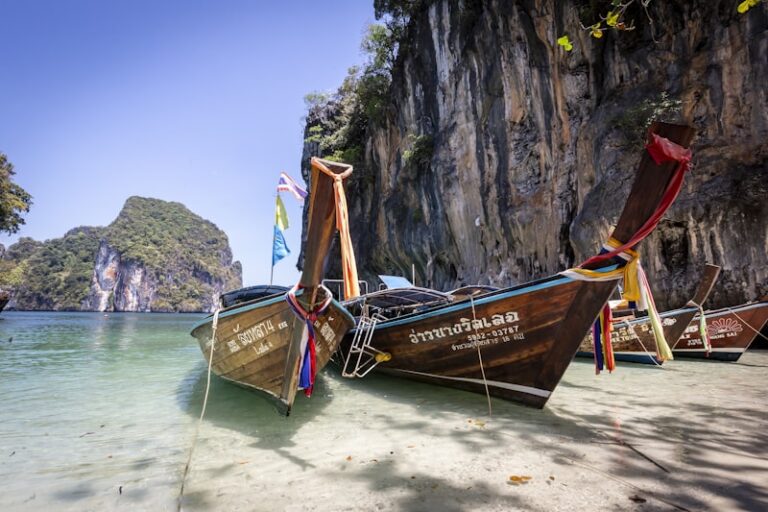
Ko Lanta sits in the Andaman Sea, south of the more famous Krabi. It’s quieter than Koh Phangan, less developed than Phuket, and has a beach road (Hat Khlong Dao and Hat Phra Ae) lined with guesthouses, restaurants, and beach bars that create a genuinely social atmosphere without the chaos of the Full Moon Party circuit. The island’s national park covers its southern third — good hiking, viewpoints, and a wild beach at the end of the road.
Ko Lanta is best from November through April. The May–October monsoon season closes many establishments. The ferry connections to Krabi town (and from there to the rest of Thailand) are straightforward. Costs are extremely reasonable — a good guesthouse with air conditioning runs $20–$40/night, and meals rarely exceed $5–$8.
Solo Beach Travel: Practical Notes
Water safety: Solo swimmers face the same risks as group swimmers with one critical difference — if you get in trouble, there’s no one immediately on hand. Research rip currents for any beach you plan to swim at. Swim at beaches with lifeguards when possible. Let someone know (hostel staff, hotel reception) if you’re going to a remote beach alone.
Valuables on the beach: A phone or camera left on a towel while you swim is simply a target — this is true everywhere, not just developing countries. Use a waterproof pouch for essentials, go in the water with only what you can’t replace, and consider a basic waterproof case for your phone over a dedicated camera if you’re going solo.
Meeting people: Solo travel at a beach is inherently more social than solo travel almost anywhere else. The shared activity of the beach — swimming, watching sunset, beach volleyball, asking for sunscreen recommendations — creates conversation naturally. Hostels with beach access or beach bars, surf schools, and day trip operators are all reliable social environments.
Updated May 2026. Travel conditions and safety contexts change — always check current advisories before booking.